Oct 28 2025 What to know this EB Awareness Week
EB Awareness Week takes place every year between 25th-31st October. It’s an international campaign to increase awareness of epidermolysis bullosa, a rare, genetic skin condition and the ‘worst disease you’ve never heard of’.
The more awareness we can raise of EB, the more support we can generate, the more funding we can put into research – and the closer we can get to a cure.
This EB Awareness Week, we’d love you to take the opportunity to find out more, and share with others.
We want everyone to know that…
 EB ‘epidermolysis bullosa’ is very painful It causes blisters and skin loss all over the body It leads to malignant skin cancer in severe types Everything we take for granted is painful for people with EB – eating, drinking, sleeping, walking EB sufferers are awesome. They are so brave, strong and full of fight There is no cure We need to research the cure to end EB pain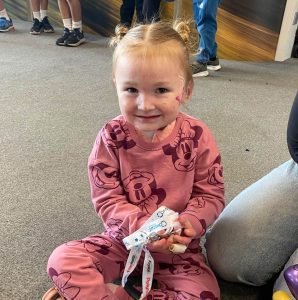
What do you have to do to be able to eat?
Poppy has recessive dystrophic epidermolysis bullosa (RDEB). Blisters and scarring in her oesophagus (food pipe) makes it narrow and eventually that means having oesophageal dilatations to open it up again to allow food to pass. This is done under general anaesthetic and the recovery is painful. Eating is painful – can you imagine that?
In her young life Poppy has had five dilatations. Many with RDEB need to have gastrostomy (tummy tubes) as well to aid feeding. Diets have to be soft or liquid in many instances. Eating should be pleasurable, not a chore or painful.
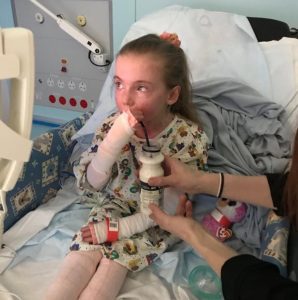
What is a ‘mitten deformity’? (pseudosyndactyly)
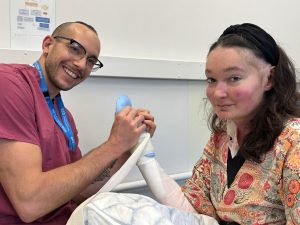
They are both smiling but Sohana is in week 7 post hand surgery to give her back her pincer grip and release contractures on some of her fingers. She is an artist, she loves to paint and draw intricate pictures but she also simply wants to be able to pick up a cup easily to drink and a spoon to eat.
RDEB scarring and contractures lead to the fingers folding up and sometimes fusing together encased in a sheet of skin. like a ‘mitten’. Simple tasks become impossible, leading to a loss of independence and increasing frustration. Surgery becomes necessary to bring back some function…. but it is brutal. It is extremely painful and the recovery time is long.
Sohana cannot wait to have the splints and dressings reduced a little more but the problem is… the contractures and scarring continues and the cycle repeats. We need gene modifying therapies, gene corrected skin grafts, we need treatments to reduce scarring and fibrosis. We need research to cure EB 🦋
What is it like looking after a new baby with EB?
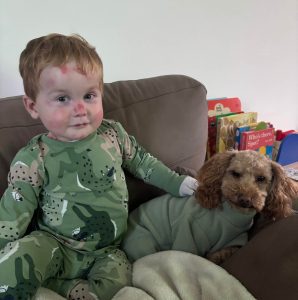
Albi is two years and two months old now. He was born with skin missing from parts of his body. The shock this would have been to his lovely young parents cannot be underestimated. The gut punch of hearing what EB will do to your new baby is immense. Then you have to pick yourself up and learn care: by trial and error, knowing that you will hurt to help, prick blisters, dress wounds for hours, try to manage pain, find clothing that works, manage nutrition – the list is quite endless.
Often one parent will drop out of work and become a carer. Families are so important. Albi has incredible support from his whole extended family, lovely grandparents and aunts and uncles and it is important to stress EB ends up affecting the whole family unit. But the most important person is at the centre, the little child who through no fault of their own has been given the horrendous burden of living with EB, having to find strength to cope with the pain every single day of their lives going forward.
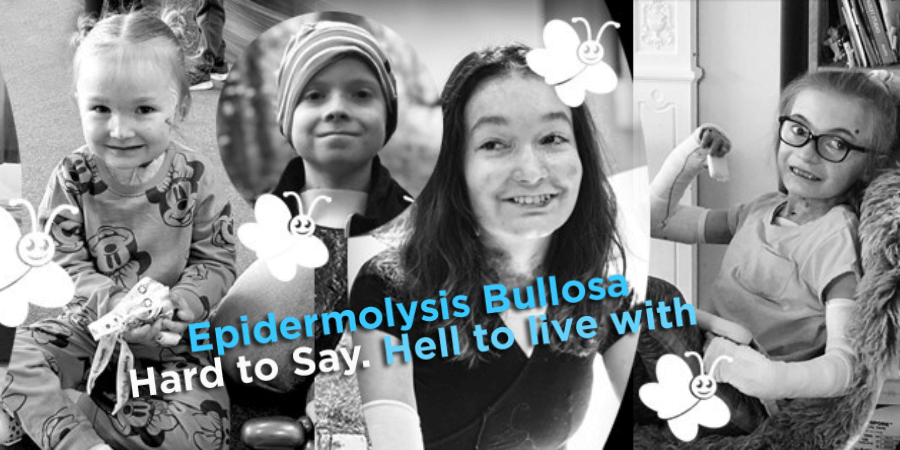
Hard to say, hell to live with
You could share this infographic which has a few facts about EB “epidermolysis bullosa’.